A Practical Guide on How to Scale Content Creation
So, you want to scale your content creation? The short answer is to blend a rock-solid strategy with the right people and smart tools. This isn't about just churning out more stuff; it's about building an efficient, predictable engine that boosts your output without letting quality slide.
The Unspoken Challenge of Content at Scale
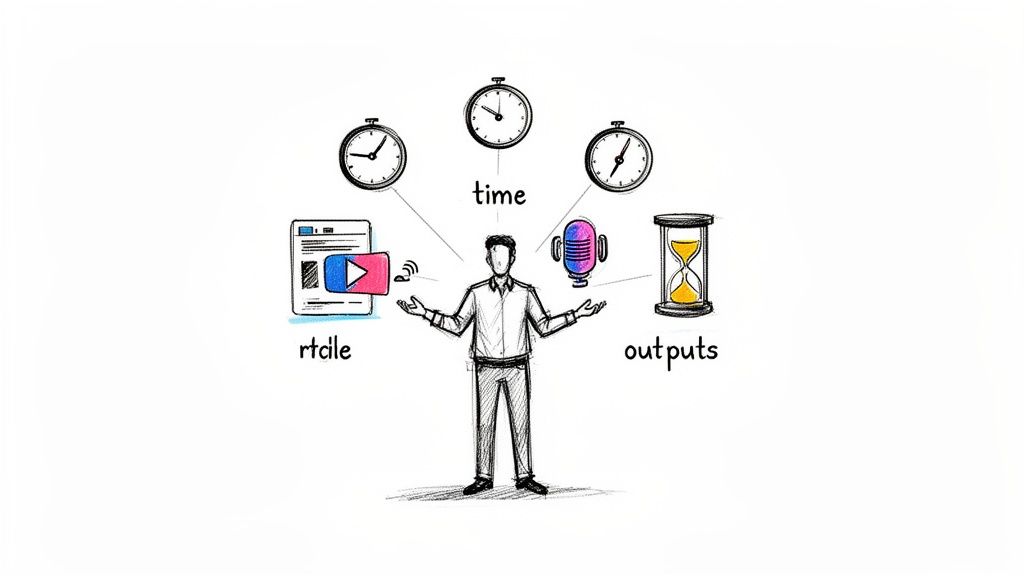
The pressure is real. You're expected to be on every platform, all the time. For most marketers and creators, this feels like an impossible treadmill, especially when you're strapped for time and resources. But here's the thing: scaling content isn't about working harder. It’s about building a smarter system.
This isn't just theory. The top creators you admire aren't superhuman—they have a well-oiled machine running behind the scenes. This guide is designed to help you build your own.
Why Your Current Process Is Hitting a Wall
If you’re here, you’ve probably hit a ceiling. My guess is your current workflow hinges on you. You're involved in everything, from the initial idea to hitting "publish." That hands-on approach is fantastic for quality when you're starting out, but it’s the number one bottleneck when you try to grow.
The problem is, you can't clone yourself. As you try to post more often or expand to new channels, either the quality starts to drop or you head straight for burnout. Real scaling means you have to stop being the doer and start being the architect of a system that works for you.
Key Insight: To truly scale, you have to shift your focus from manually producing content to designing the system that produces it. The goal is a repeatable process that delivers consistent results with less of your direct effort.
What Are the Pillars of Scalable Content?
To break through that ceiling, we need to focus on three core areas that are the foundation of any great content engine. Each one solves a specific problem that holds most creators back. Getting these right gives you an immediate framework to multiply your impact.
Here's a simple breakdown of how these pillars fit together.
The Three Pillars of Scalable Content Creation
By getting a handle on these three areas, you'll learn how to scale content creation methodically. We're moving beyond just "making more posts" and into building a sustainable system that will fuel your growth for years to come.
Building Your Content Engine and Cadence
Before you even think about scaling up, you need a blueprint. Just trying to create more stuff without a real strategy is a recipe for burnout and mediocre results. That blueprint is your content engine—a repeatable system that ensures everything you produce actually supports your business goals.
So, what's the point of all this content? Are you trying to grow your audience? Generate leads? Cement yourself as the go-to authority in your niche? Your answer changes everything. A content engine designed for lead gen will look completely different from one built for brand awareness. Get crystal clear on this now, because it'll save you a ton of wasted effort down the road.
Defining Your Pillar Content
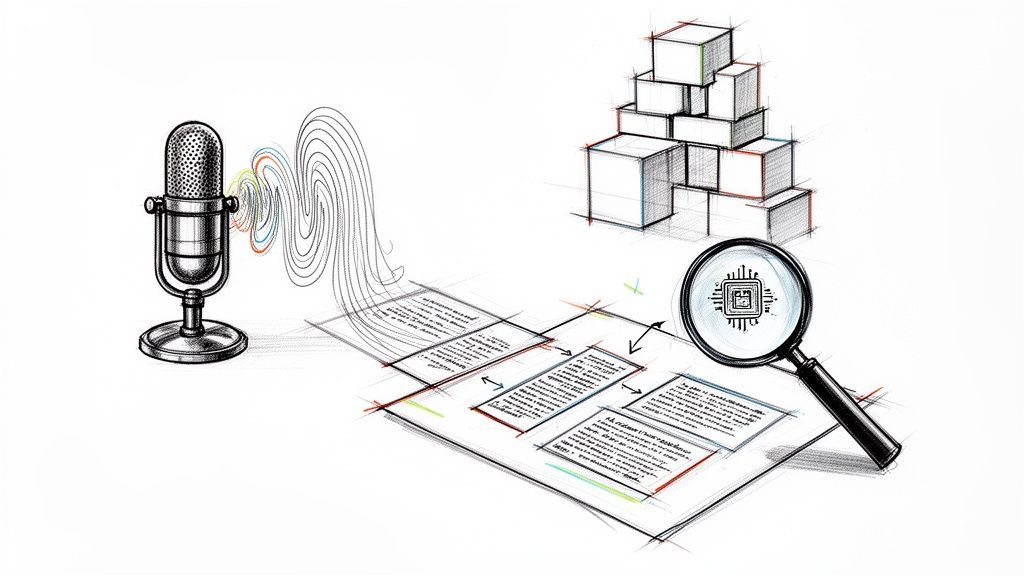
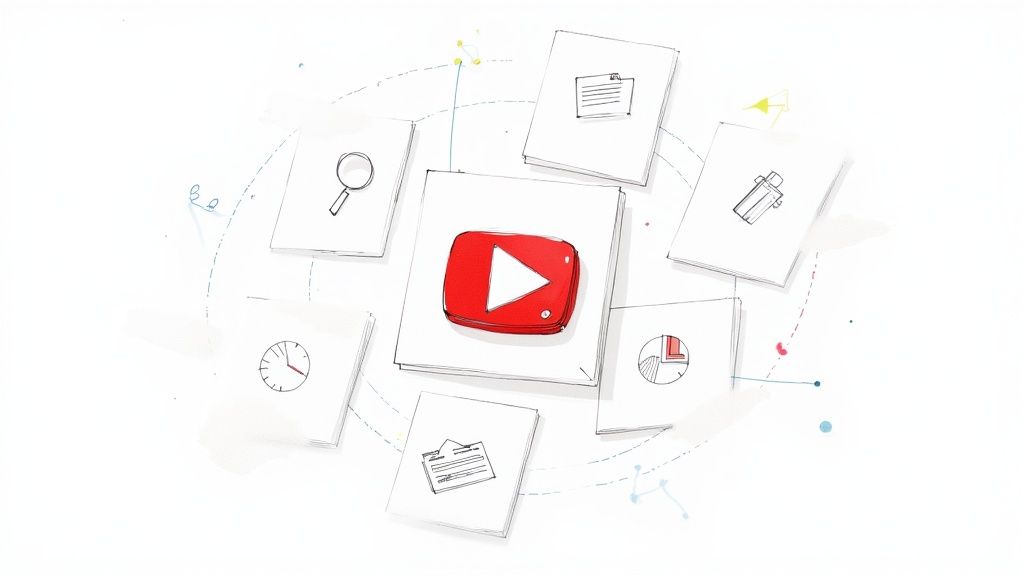
At the heart of any scalable content strategy is your pillar content. This is the one big, valuable thing you commit to creating on a consistent schedule. It's the sun, and all your other smaller content pieces are the planets orbiting it.
Your pillar content should feel natural to you. If you’re a great talker, maybe a weekly podcast is your jam. If you come alive on camera, a long-form YouTube video makes perfect sense. The specific format isn’t nearly as important as its depth and your ability to stick with it.
Based on my experience, a few common examples that work really well are:
- A weekly in-depth podcast where you interview other industry experts.
- A bi-weekly educational YouTube video that unpacks a complicated topic for your audience.
- A monthly data-heavy research report or a deep-dive case study.
- A live Q&A session hosted on a platform like LinkedIn or YouTube.
The trick is to pick one primary format and get really, really good at producing it. This becomes the "single source of truth" that you'll slice and dice into dozens of other assets.
From Pillar Content to a Spiderweb of Assets
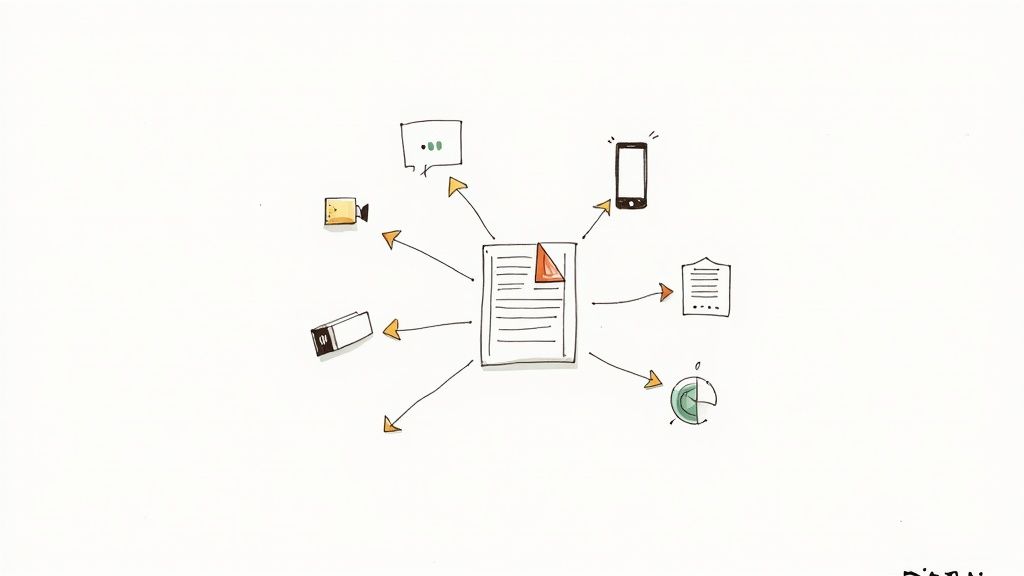
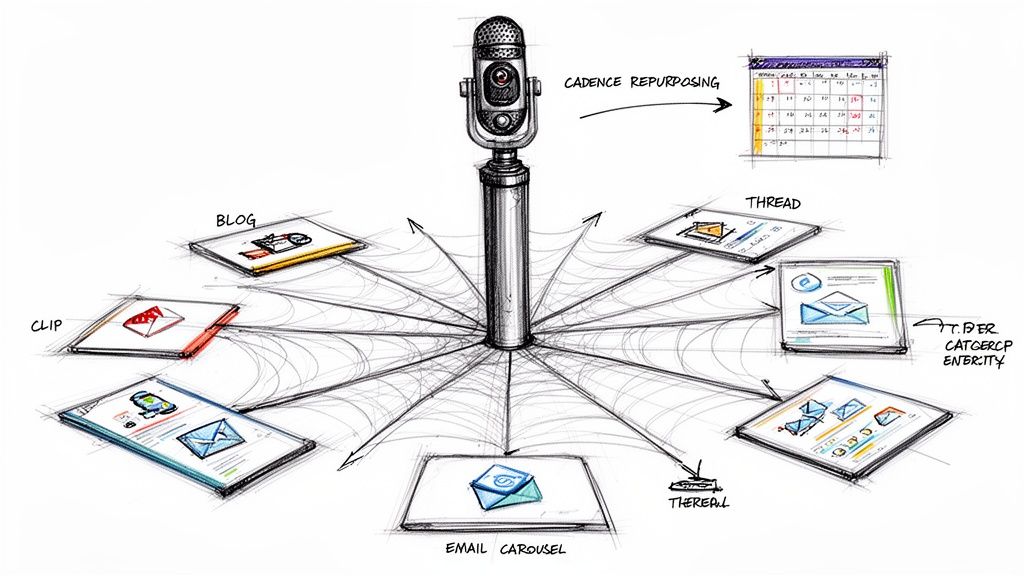
Once you’ve got your pillar content locked in, the real scaling magic happens. This is where you ditch the "one-and-done" mentality and embrace a repurposing model. Think of your pillar as the center of a spiderweb. Every other piece of content you create is just another thread extending from that center.
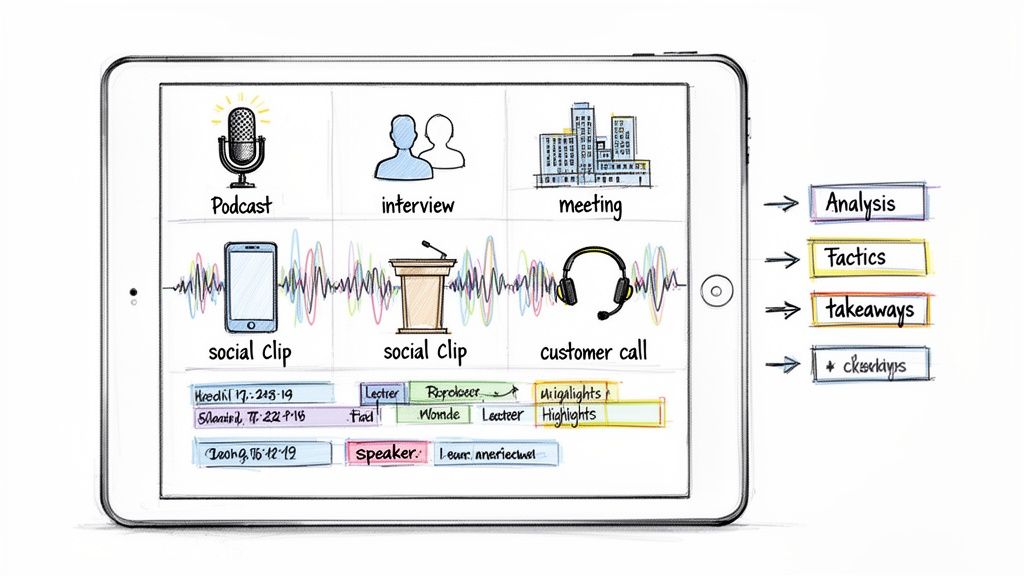
Let’s walk through a real-world scenario. Imagine your pillar content is a 45-minute podcast episode. From that single recording, you can easily spin out an entire month's worth of content for every platform you're on.
By focusing on one high-effort pillar and then atomizing it into smaller pieces, you're not creating more work. You're simply maximizing the value of the work you've already done.
This mindset shift is fundamental to understanding how to scale content creation without multiplying your recording time. You’re making one asset work ten times harder for you.
Mapping Out Your Content Cadence
Your content cadence is simply your publishing rhythm. It has to be ambitious enough to keep your audience hooked but realistic enough that your team doesn't revolt. Trust me, an unsustainable pace is far worse than a slow one. It leads to inconsistency, and inconsistency kills audience trust.
Sticking with our podcast example, here’s what a sustainable, high-impact cadence could look like:
Pillar Content: One 45-minute podcast episode, recorded every week.
Derivative Assets & Distribution Cadence:
Day 1 (Launch Day):
- Push the full audio episode live on all podcast platforms.
- Upload the full video of the conversation to YouTube.
- Fire off an email newsletter to your subscribers announcing the new episode and sharing a few key takeaways.
Day 2:
- Publish a full-length blog post on your site, built from the episode's transcript and summary.
- Share that blog post on your company's LinkedIn and Twitter profiles.
Days 3-5:
- Drop 2-3 short video clips (think 30-90 seconds) on TikTok, Instagram Reels, and YouTube Shorts.
- Create a text-based carousel post for LinkedIn highlighting three of the most powerful quotes from your guest.
Day 6:
- Post an audiogram (a static image with an audio snippet) on social. Ask a question related to the clip to get a conversation started.
The Editor: This is your quality control. They take your raw material—be it a video recording or audio file—and do the heavy lifting in post-production. For a podcast, that means cleaning up the audio, cutting out the 'ums' and 'ahs,' and mixing in your music. For video, they're handling the cuts, adding B-roll, and getting the color just right.
The Writer/Repurposer: This person is the engine of your content scaling. They take the polished pillar content and masterfully spin it into gold. Using a transcript, they might write a comprehensive blog post, pull out snappy quotes for Twitter, or draft a newsletter that summarizes the key takeaways. They are masters of content atomization.
The Social Media Manager/Distributor: This role closes the loop. They take all the finished assets and make sure the right people actually see them. Their job involves scheduling posts with compelling captions, engaging with comments, and keeping an eye on which platforms and formats are getting the most traction.
Grab the Raw Materials:
- The final audio file is in our shared
Google Drive > Podcast Episodes > Final Audiofolder. - The AI-generated transcript and summary are in the
Whisper AI > Transcriptsfolder.
- The final audio file is in our shared
Draft the Blog Post:
- Create a new Google Doc using our "Podcast Blog Post Template."
- Use the AI summary to write a hooky introduction (around 100-150 words).
- Read through the transcript and pull out the 3-5 main ideas. These become your H2 subheadings.
- Flesh out each section with detail, using the transcript to quote the guest or make specific points.
- Find 2-3 powerful quotes and format them as blockquotes to break up the text.
Polish & Prep for Publishing:
- Run the draft through Grammarly for a final grammar and spelling check.
- Make sure our main keyword is in the title, the first paragraph, and at least two subheadings.
- Drop the link to the finished Google Doc in the "Ready for Review" channel in Slack for my final look.
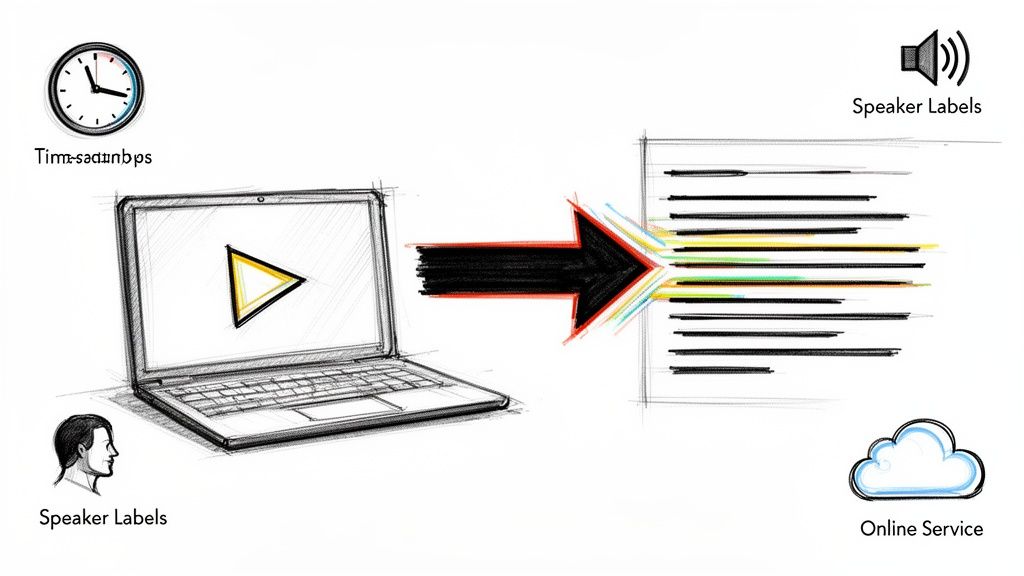
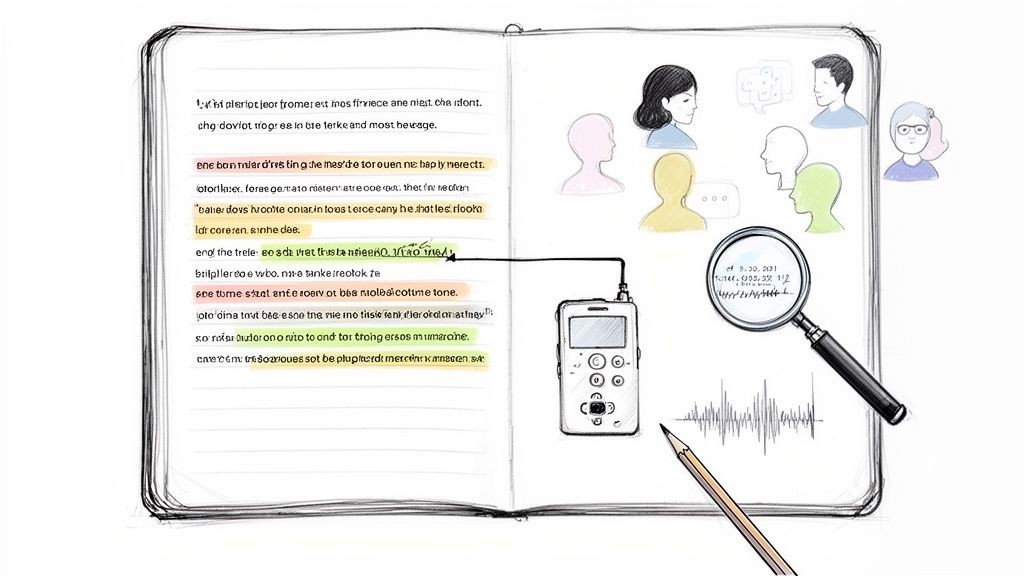
- A Full, Accurate Transcript: The entire conversation, converted to text and complete with timestamps.
- Speaker Detection: The transcript clearly identifies who is speaking, which is a lifesaver for readability and pulling quotes.
- A Concise Summary: The AI boils down the full hour into a few powerful paragraphs, nailing the main arguments and takeaways.
- Bulleted Highlights: The most important points are pulled into a simple, skimmable bullet-point list.
Draft a Comprehensive Blog Post: Your writer grabs the full transcript and the AI summary. The summary becomes the intro, the key talking points become subheadings, and the transcript provides the direct quotes to flesh everything out. A post that used to take hours is now 80% done in minutes.
Generate Engaging Social Media Threads: Just pull the bullet-point highlights straight from the AI output. Each bullet can be a tweet in a Twitter thread or a slide in a LinkedIn carousel. Add a bit of context, and you’ve got social content for the week.
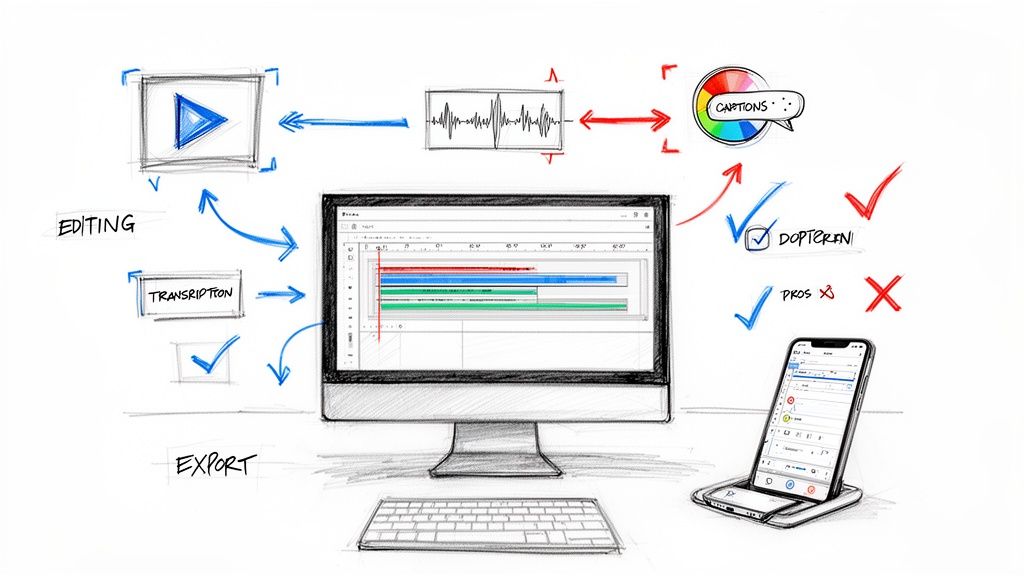
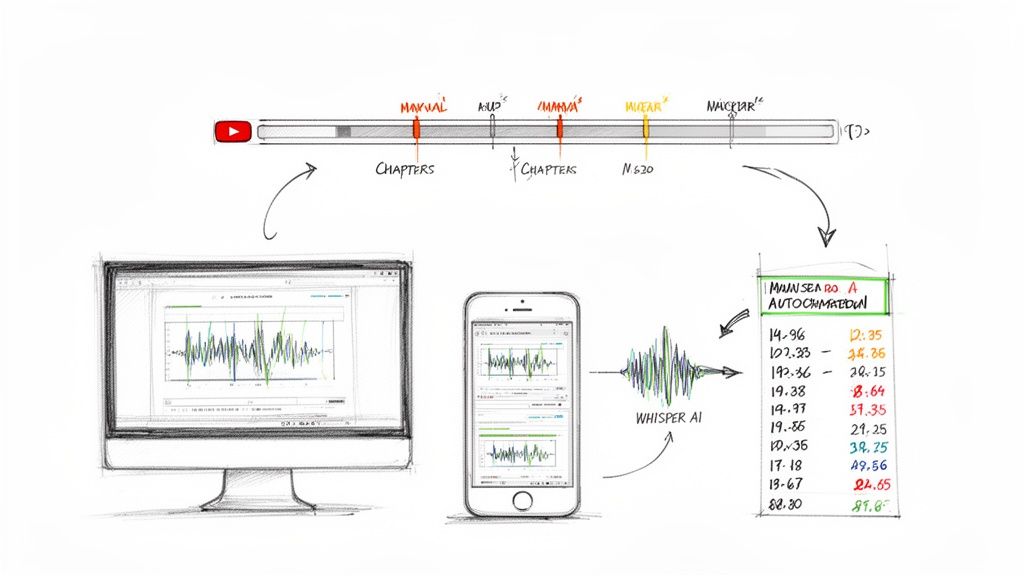
Create Accurate Video Captions: If your interview was on video, the timestamped transcript can be exported as an SRT caption file. This is huge for accessibility and engagement on platforms like YouTube and LinkedIn, where so many people watch with the sound off.
Write a Compelling Email Newsletter: Use the AI-generated summary as the core of your next newsletter. You can announce the new episode and give subscribers the key takeaways without them having to commit to the full hour. It provides instant value and drives traffic back to your main content.
- [Post Title]: Start with the main topic of the episode, optimized for a target keyword.
- [Featured Image]: Create a visually relevant graphic.
- [Introduction - 150 words]: Use the AI-generated summary as your first draft. Polish it into a hook that immediately grabs the reader.
- [Embedded Media]: Embed the full YouTube video or audio player right below the intro.
- [Subheading 1 - Key Point]: Pull the first major idea from the AI highlights. Flesh out this section with direct quotes from the transcript.
- [Blockquote]: Find a powerful, insightful quote from this part of the transcript and make it stand out.
- [Subheading 2 - Second Key Point]: Repeat the process for the next main idea, building out the body of the article.
- [Conclusion - 100 words]: Briefly recap the core message and finish with a strong Call-to-Action (CTA).
- Slide 1 (The Hook): A bold question or a punchy statement from the episode.
- Slide 2 (The Context): A snippet from the AI summary to quickly set the stage.
- Slide 3 (Point 1): The first bullet point from the AI highlights.
- Slide 4 (Point 2): The second bullet point.
- Slide 5 (Point 3): The third bullet point.
- Slide 6 (The CTA): "Listen to the full episode to learn more. Link in bio."
- Engagement Rate Per Post: This tells you how much your audience is actually interacting with a specific piece of content. A high rate means your message is hitting the mark; a low one suggests a disconnect.
- Website Traffic from Social Channels: This metric is crucial because it directly links your social media hustle to your website—your primary business hub. It shows if your content is successfully pulling people into your world where conversions happen.
- Conversion Rates on Lead Magnets: If you're creating content to generate leads, this is your bottom line. Tracking how many people download your guides or sign up for your newsletter reveals how persuasive your content really is.
- Audience Retention on Videos: For video content, this metric is pure gold. It shows you the exact moment viewers start dropping off, helping you identify boring segments and double down on what keeps them glued to the screen.
- What was our best-performing piece of content and why? Pinpoint the format, topic, and platform. What made it work?
- What was our worst-performing piece of content? Get honest about what fell flat. Was it the hook, the visuals, the topic itself?
- Which channel drove the most valuable traffic? Look beyond just clicks. See which platform sent visitors who stayed longer or converted more often.
- Based on this data, what one change will we test next month? Don't try to overhaul everything at once. Make one specific, informed adjustment and measure its impact.
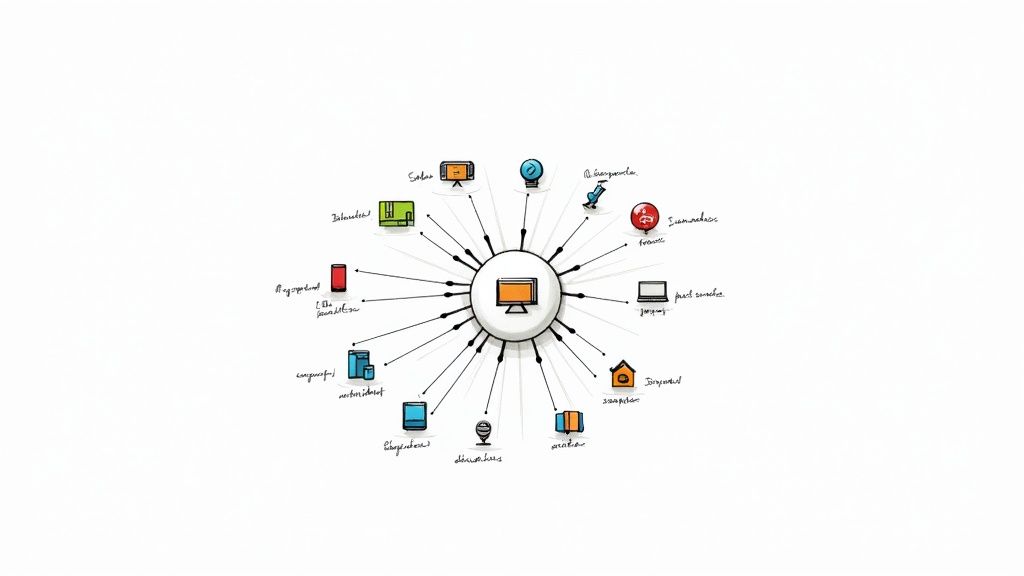
With this system, one recording session turns into more than a dozen coordinated touchpoints across your channels, all hammering home the same core message. It creates a steady drumbeat of value for your audience while being a totally manageable process for your team. This is the engine that drives real, scalable growth.
Building Your Content Machine: Team Roles & SOPs
To truly scale your content, you have to make a crucial mindset shift: stop being the sole creator and start being the architect of a content system. This doesn't mean you need to hire a huge, expensive team right away. In my experience, most successful creators started by hiring just one key person—often a virtual assistant—to handle the most tedious, repetitive tasks.
The whole point is to build a lean, efficient team where everyone knows exactly what they own. That clarity is the secret sauce. Without it, you'll get bogged down in managing people instead of creating. When you have a well-oiled machine, you're free to focus on what only you can do, whether that's recording a killer podcast, shooting a video, or writing from your unique point of view.
The Core Roles in Your Content Engine
Even if you’re wearing all the hats at first, it’s vital to think in terms of roles, not just people. Defining the distinct jobs that need to get done helps you see the entire workflow as a system. This framework makes it so much easier to plug people in as you grow.
Most scalable content operations boil down to three key roles:
You can start by just outsourcing one of these. For many creators, the editor is the first hire because post-production is an absolute time-vampire. Once that's off your plate, you'll be amazed at how much more mental energy you have to just create.
The Magic of Standard Operating Procedures (SOPs)
A team is great, but it's only half the equation. The real key to scaling without your quality taking a nosedive is creating Standard Operating Procedures (SOPs). Don't let the corporate-sounding name fool you; an SOP is just a detailed, step-by-step checklist for every task in your workflow. It's the playbook that ensures things get done your way, every single time.
SOPs are the purest form of delegation. You're not just handing off a task; you're transferring your knowledge and standards to your team. This is how you build a system that runs without you, and it's how you truly buy back your time.
Think about it like a recipe. If you just tell someone to "bake a cake," you’ll get all sorts of weird results. But if you give them a detailed recipe with exact measurements and clear instructions, you're going to get a perfect cake almost every time. Your SOPs are the recipes for your content.
Creating Your First Content SOP
Don’t get overwhelmed trying to document your entire existence at once. Just start with the very next process you plan to delegate. Let’s say you’re hiring a writer to turn your podcast episodes into blog posts.
Here’s what a practical SOP for that task might look like:
This level of detail takes the guesswork out of the equation. It empowers your new hire to hit the ground running and work confidently. This is how you turn a messy, creative task into a predictable, repeatable system—which is the heart of scaling your content.
Automating the Grind with AI and Smart Tooling
Once you’ve built a lean team and crystal-clear SOPs, you’ve got the chassis of your content machine. Now, it's time to drop in the engine. Smart tooling, especially AI-powered platforms, is what gives your system the horsepower to really scale. This is how you finally kill off the soul-crushing, repetitive work that burns through your most precious resource: time.
The point isn't to replace human creativity. It's to automate the grind. When you offload manual tasks like transcription, summarizing, and basic formatting, you empower your team to focus on what actually moves the needle—strategy, storytelling, and connecting with your audience. This is where you’ll see the real payoff.
The market reflects this shift. The global digital content creation platform market is expected to jump from $5.15 billion in 2025 to $5.65 billion in 2026, driven by a 27% year-over-year surge in platform use. For creators serious about scaling, this means getting comfortable with AI tools. Take Whisper AI, which has already processed over 500,000 files—that’s more than 60,000 hours of media—for its 50,000 users. It’s how podcasters are turning hours of transcription drudgery into a task that takes just minutes. You can dig into the data yourself in Intel Market Research's analysis of the digital content creation platform market.
From Raw Media to Ready-to-Publish Assets
Let's make this real. Imagine you just wrapped up a fantastic, hour-long podcast interview. In the old days, what came next was a mountain of manual post-production tasks. It’s daunting.
But with an automated workflow, the picture changes completely.
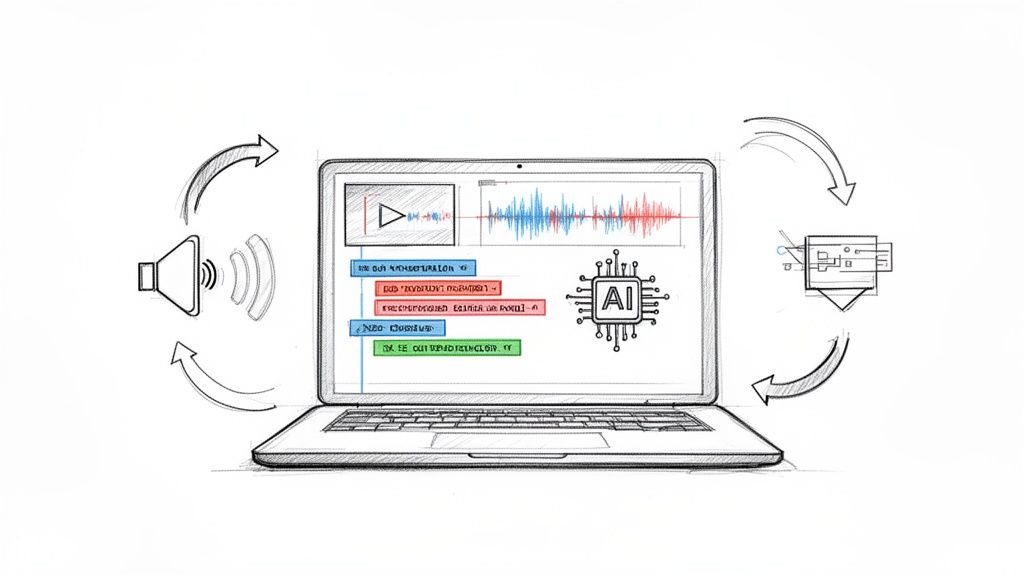
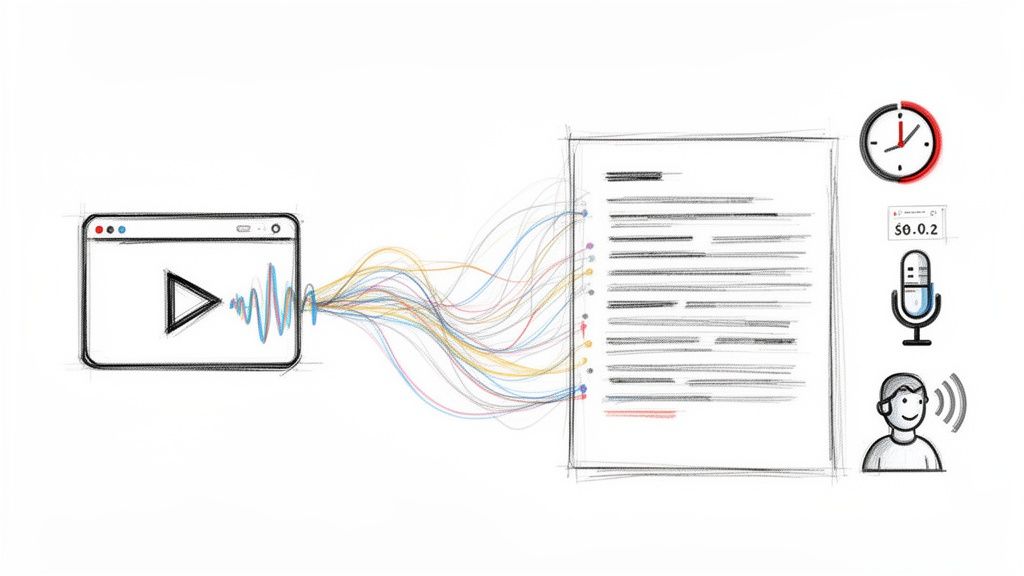
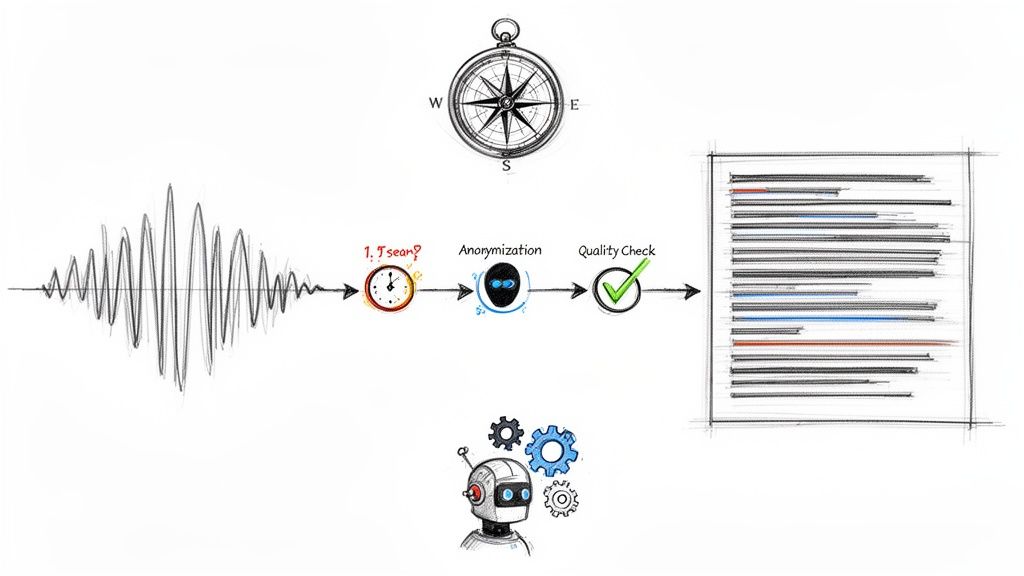
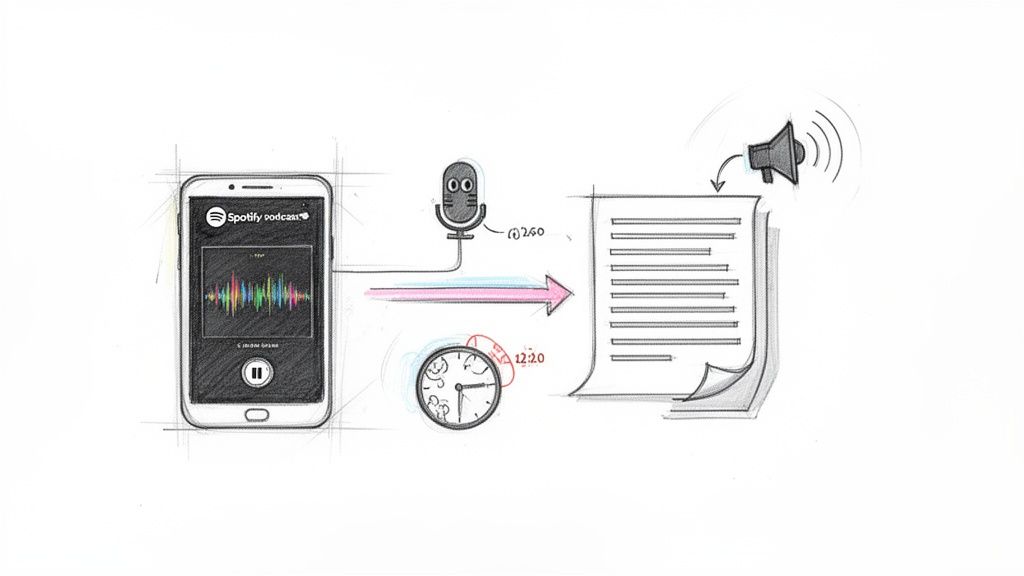
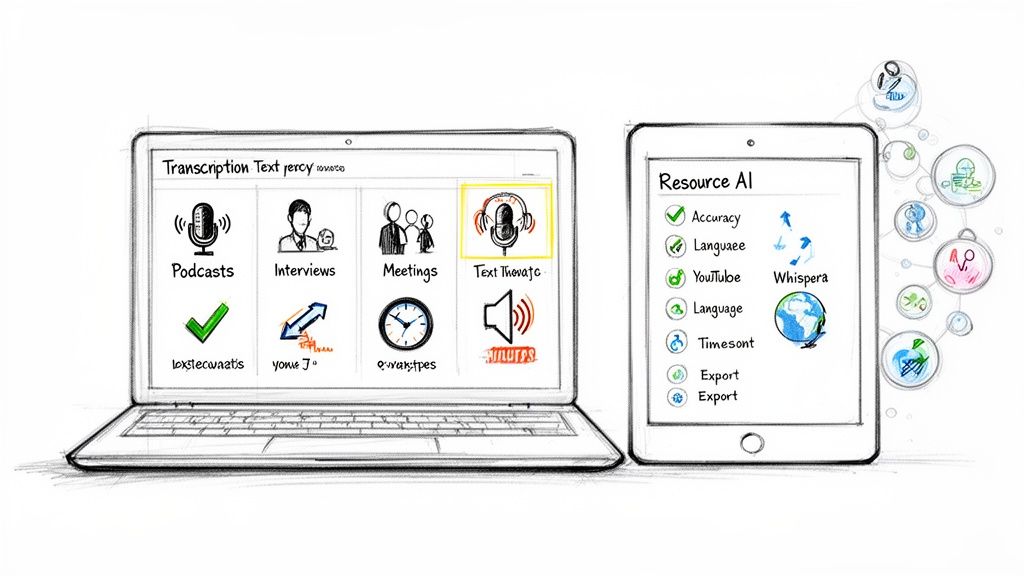
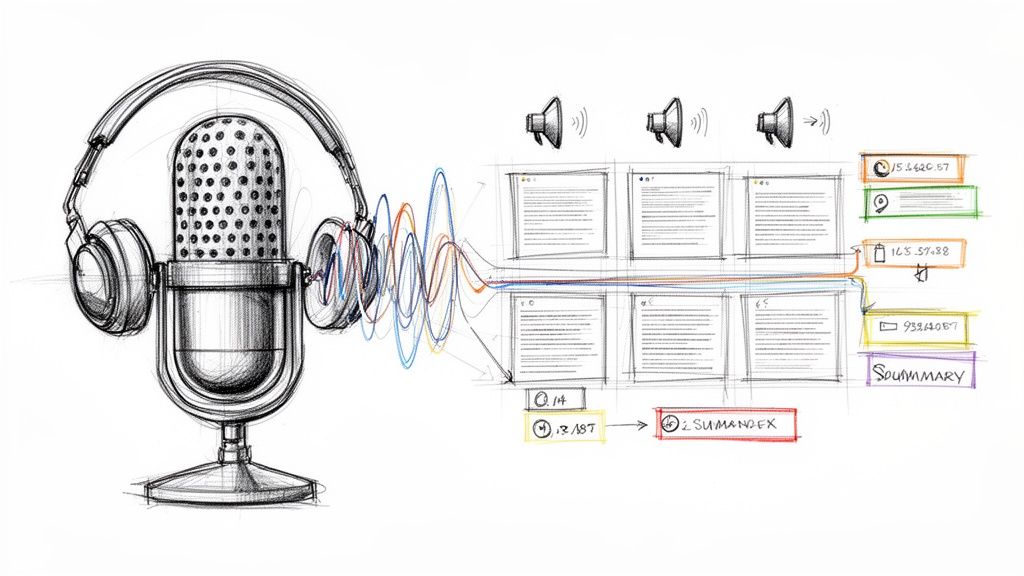
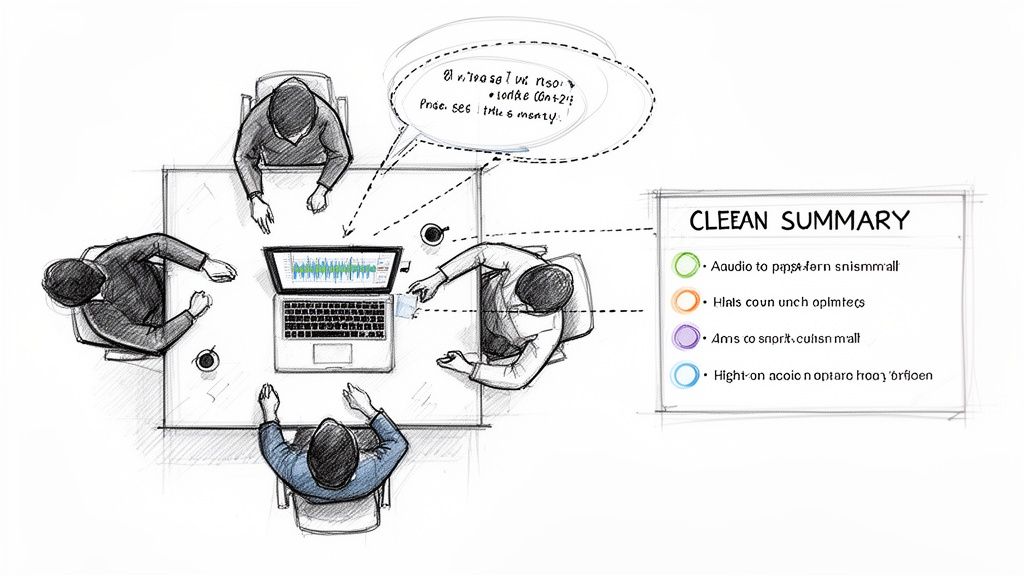
You upload that one-hour audio file to a platform like Whisper AI. Within minutes, the system kicks into gear, handling several tasks at once that would have previously required hours of work or multiple freelancers.
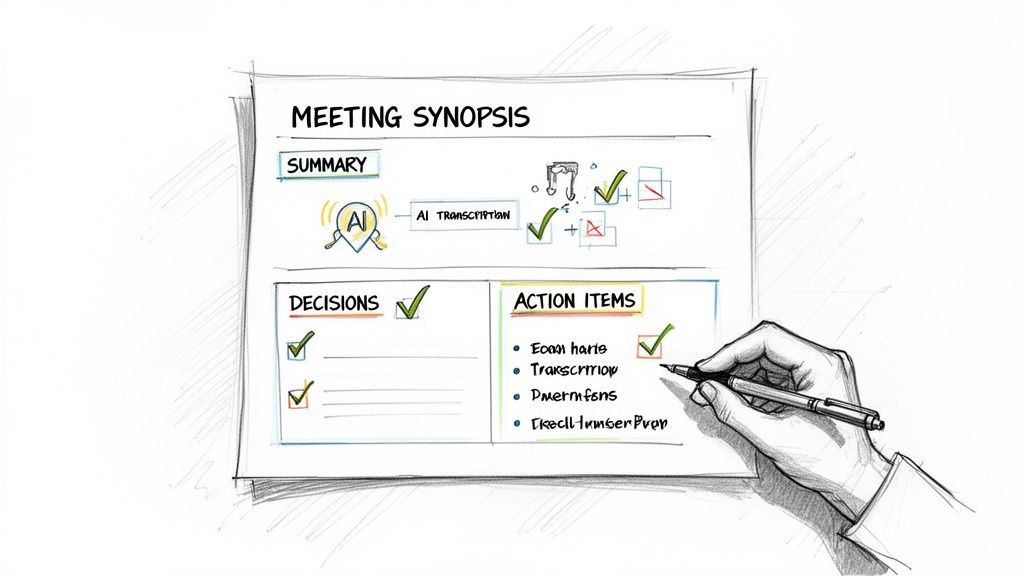
Almost instantly, you get several core assets:
This single automated step is the cornerstone of scaling content. It turns one unstructured media file into a handful of structured, usable text assets. This becomes the raw material that fuels your entire content repurposing engine.
Building Your Automated Content Repurposing Workflow
With these foundational assets in hand—the transcript, summary, and highlights—your team can now execute the content plan at an incredible pace. You're no longer staring at a blank page. You're assembling and refining.
This is what it looks like in practice. You define the roles, set up the SOPs, and then let automation handle the heavy lifting so your team can focus on creating.
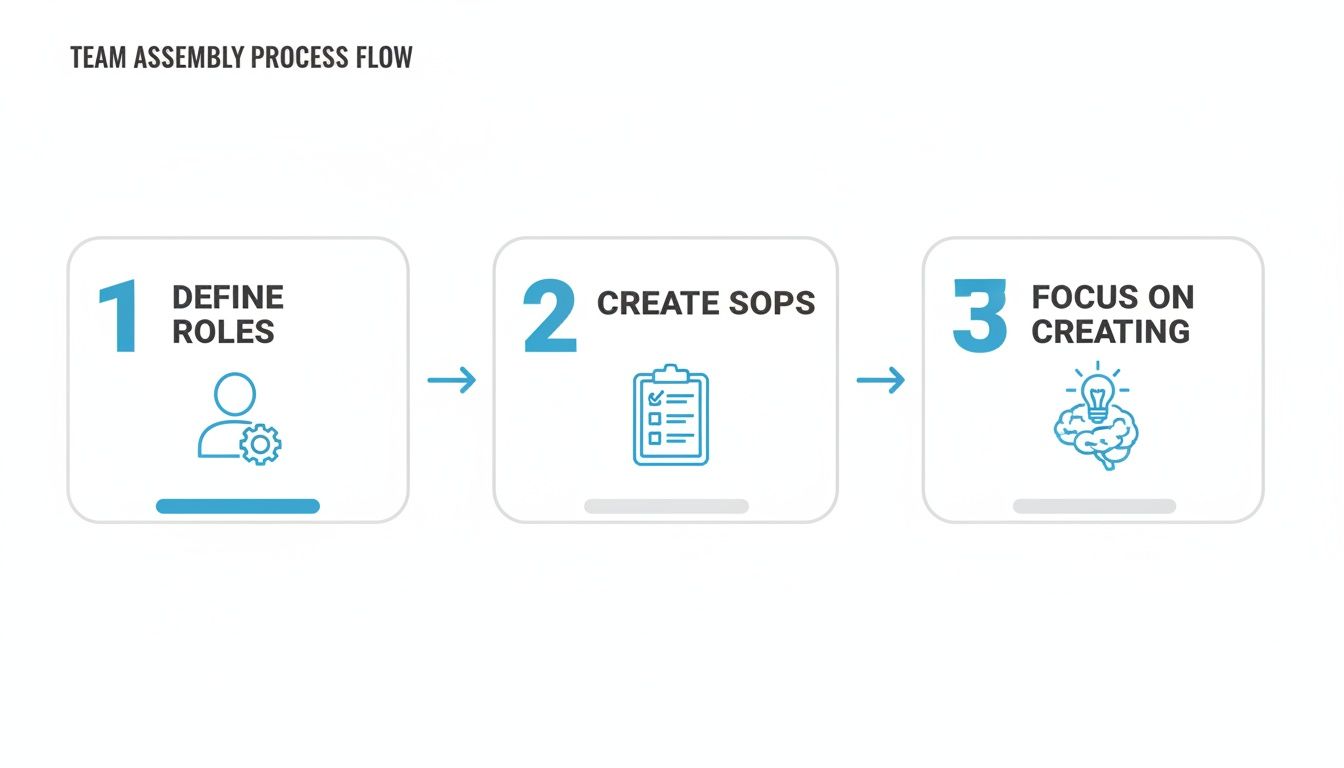
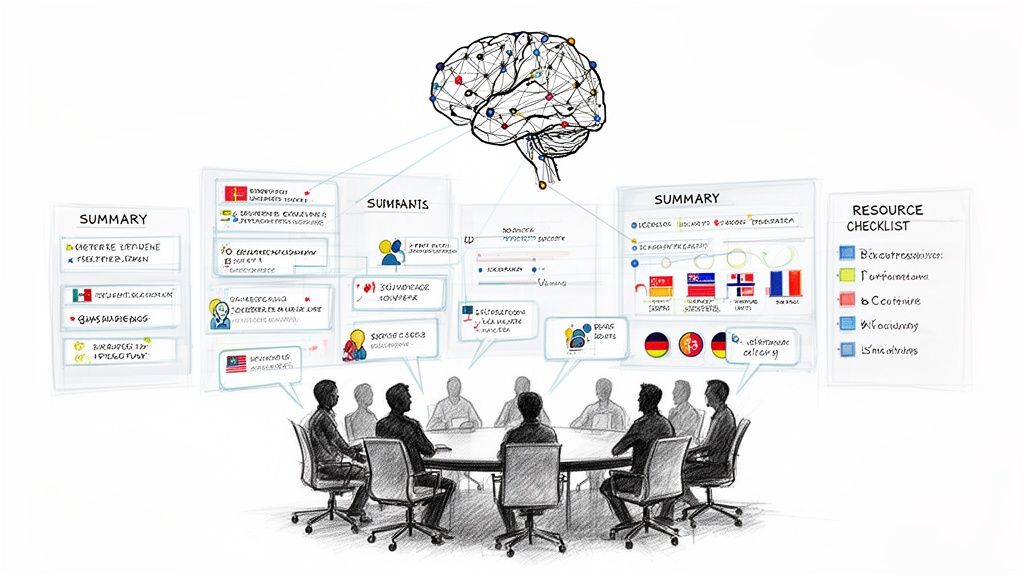
Here’s how you can use those AI-generated assets to spin up a full suite of content for every platform:
This is how to scale content creation—by building an assembly line. Each piece flows logically to the next, with automation handling the most time-consuming parts. It’s the secret behind how top creators turn a single recording session into a month's worth of high-quality content across multiple platforms. To dig deeper, check out our guide on content creation tools for social media to find even more ways to streamline this process.
How to Speed Up Your Workflow with Smart Content Templates
You've got your automation set up. Raw transcripts and summaries are flowing in from your tools. So what's the holdup? For many, this is exactly where the content machine grinds to a halt. The bottleneck shifts from generating raw material to shaping it into finished, on-brand content.
Without a system in place, every new blog post, social media update, or newsletter becomes a series of small, repetitive decisions. This constant "decision fatigue" is a creativity killer and the single biggest drag on your production speed.
The answer is surprisingly simple: content templates. These aren't just outlines; they're pre-built, fill-in-the-blank frameworks for your most common content formats. Think of them as production shortcuts that let your team skip the busywork and get straight to creating. Instead of starting from a blank page, they work from a proven blueprint that ensures consistency, quality, and—most importantly—speed.
What a Good Template Actually Does
A truly effective template does more than just list out H2s and H3s. It's a strategic framework built to work hand-in-glove with the outputs from your AI tools. It creates a seamless assembly line, taking a raw transcript or summary and guiding it toward a polished, published asset.
The best templates strike a delicate balance. They provide just enough structure to guarantee brand consistency while leaving plenty of room for creative flair. Your team shouldn't feel like they're just checking off boxes. The goal is to empower them to produce better content, faster than ever before.
The real magic of a template isn't just what it includes, but what it removes. It eliminates the mental load of figuring out format, structure, and style for every single piece of content. By standardizing 80% of the work, you free up your team to pour their creative energy into the crucial 20% that makes your content truly stand out.
Practical Templates for Your Production Line
Let’s get specific. Here’s how you can turn a single podcast episode into multiple assets using templates designed to work with AI-generated outputs, like those from a tool like Whisper AI.
The AI-Enhanced Blog Post Template
This template is all about turning a long transcript into a comprehensive article without the long hours.
This structure transforms a potentially daunting writing task into a much more manageable assembly job. You’re not writing from scratch; you’re strategically organizing pre-existing information into a valuable new format. For more ideas on how to spin one piece of content into many, check out these content repurposing strategies that pair perfectly with this model.
The Social Media Carousel Template (LinkedIn/Instagram)
Carousels are fantastic for breaking down big ideas into bite-sized, shareable visuals. This template pulls directly from your AI highlights.
The digital content creation industry is on a massive growth trajectory, projected to jump from $27.1 billion in 2023 to $90.4 billion by 2033. To get a piece of that pie, efficiency is non-negotiable.
With 94% of marketers planning to use AI for content creation by 2026, using tools to instantly turn videos into summaries for these templates isn't just a clever trick—it's quickly becoming the standard for anyone serious about scaling their output. These are the kinds of digital content creation statistics that show why building a smart, automated system is no longer optional.
Measuring What Matters to Track Your Content KPIs
Trying to scale up your content creation without measuring its impact is like driving blind. Sure, you're putting your foot on the gas, but you have no clue if you're actually getting closer to your destination. To know if all this effort is paying off, you absolutely have to track the right Key Performance Indicators (KPIs).
This isn’t about chasing vanity metrics like raw follower counts or a flurry of likes. Real success is found in the numbers that signal genuine audience connection and, ultimately, business growth. Shifting your focus to these metrics is the key to making smart, data-driven decisions that continuously refine your entire content engine.
Moving Beyond Vanity Metrics
It's easy to get hooked on numbers that feel good but don’t tell you anything truly useful. It's time to dig deeper. The real signs of a healthy content strategy are tied directly to how your audience behaves and whether you're hitting your business goals.
When you're scaling up, these are the KPIs that actually matter:
The content marketing space is massive and only getting bigger, projected to hit $1.95 trillion by 2032. With social media ad spend expected to reach $277 billion by 2025, it’s a crowded field. In fact, 94% of marketers are now using AI to get an edge. Tools like Whisper AI are a huge help here, turning a single video clip into transcripts and summaries that let teams repurpose content and save countless hours. You can dive deeper into these content marketing statistics to see just how critical efficiency has become.
The Monthly Performance Review Framework
Having all this data is useless if you don't do anything with it. The best way to use your KPIs is by setting up a simple, consistent review process. Think of it as a monthly check-up for your content engine—a vital feedback loop that makes it smarter over time.
Carve out some time each month to pull all your data into one place. Look for trends, celebrate the wins, and dissect the losses.
By dedicating time to a monthly review, you stop guessing and start knowing. This feedback loop is the single most important habit for turning your content machine into a system that consistently delivers real business results.
During your review, analyze your data by asking these four critical questions:
This straightforward process ensures you're constantly learning and improving, making every piece of content you create more effective than the last.
Your Top Content Scaling Questions, Answered
When I talk to creators about scaling their content, a few practical questions always pop up. It's easy to get bogged down by the "what ifs," so let's clear up some of the most common roadblocks you might be thinking about.
How can I scale with a small budget?
This is a big one. The key is to start with strategy, not a huge pile of cash. Forget trying to be everywhere at once. Instead, pour your energy into creating one high-value "pillar" piece of content each week. This could be a solid podcast episode, a detailed video, or a live webinar.
From there, it's all about smart repurposing with low-cost tools. An AI transcription service, for instance, can take that one media file and instantly generate a full transcript, a concise summary, and key highlights. You can then take those assets and manually craft social media posts, a blog article, and even an email newsletter. The small initial investment in an automation tool will pay for itself almost immediately in the hours you get back.
Will AI and templates make my content sound robotic?
Absolutely not—if you use them as a starting point, not a finish line. Think of it this way: AI and templates are there to handle 80% of the grunt work. Your job is to come in and add the final 20%—the human touch, the unique insights, and the personal stories that make your content yours.
Use AI to get the raw materials on the page, like a rough draft or a transcript. Then, you step in to refine the message, inject your authentic voice, and add your expertise. Templates give you a reliable structure, but they don't provide the personality. They ensure your output is consistent, leaving you free to fill it with content that's genuinely you.
To make sure all this scaled content is actually moving the needle, you need to know how to measure its impact. For a deeper look at evaluating your efforts, this guide on how to Maximize Your Content Marketing Return On Investment is a must-read.
Ready to take the most tedious parts of your content workflow off your plate? Whisper AI turns your audio and video into accurate transcripts, summaries, and highlights in minutes. Start scaling your content today.